
Politics
POPE LEO XIV’S FRANCE VISIT BRINGS FAITH, HUMAN DIGNITY & EUROPEAN UNITY
INTO A COUNTRY UNDER PRESSURE
Holly Pope visits france (Source: Vatican Communication)
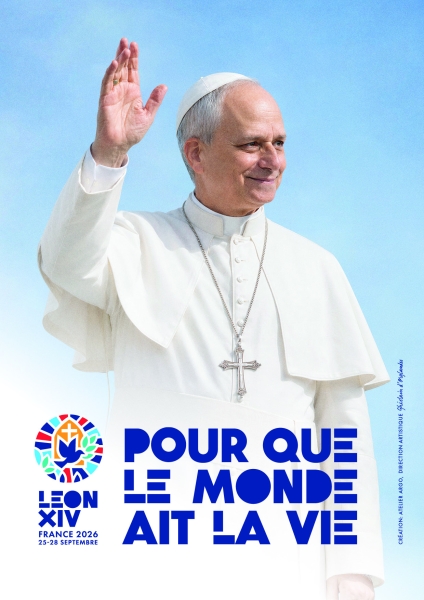
Holly Pope Waving prayers
(Source: Vatican Communication)
(Source: Vatican Communication)
There are 210 days until the first round of the French presidential election on 18 April 2027, and 224 days until a potential second round on 2 May. Emmanuel Macron, who cannot seek a third consecutive term, remains President at a time when his government faces a punishing budget debate and a public debt that reached €3.5361 trillion, 117.5 percent of gross domestic product at the end of the first quarter of 2026. (Source INSEE)
Leo XIV will not offer a political program for France. Nor should he. But his route from UNESCO’s international stage to the sick and disabled pilgrims of Lourdes, and finally to a European encounter in Metz, makes this more than a unique ceremonial visit.

Notre Dame de Paris Picto
Source: Vatican Communication
Source: Vatican Communication
AN AMERICAN POPE WITH A FRENCH ROOT
Pope Leo XIV, born Robert Francis Prevost in Chicago and elected pope in May 2025, is the first pontiff from the United States. His visit therefore carries a natural transatlantic dimension at a time when relations between Europe and the United States are being reconsidered through security, trade, technology and global conflicts.
But France is not entirely foreign territory for him. His paternal grandmother, Suzanne Marie Louise Fontaine, was born in Le Havre in Normandy in 1894. That family connection does not turn the Pope into a French political figure, and it should not be over-romanticised. Yet it adds a human thread to a journey that will carry him from Paris to Lourdes and then to Metz, a borderland city that embodies European reconciliation.
The Vatican has framed the visit as an apostolic journey, not a state visit. That distinction matters. The Pope is also a head of state, but he is coming first as the Bishop of Rome and leader of the Catholic Church to pray, speak, meet believers and address questions of human dignity and peace. (Source Vatican)
Pope Leo XIV, born Robert Francis Prevost in Chicago and elected pope in May 2025, is the first pontiff from the United States. His visit therefore carries a natural transatlantic dimension at a time when relations between Europe and the United States are being reconsidered through security, trade, technology and global conflicts.
But France is not entirely foreign territory for him. His paternal grandmother, Suzanne Marie Louise Fontaine, was born in Le Havre in Normandy in 1894. That family connection does not turn the Pope into a French political figure, and it should not be over-romanticised. Yet it adds a human thread to a journey that will carry him from Paris to Lourdes and then to Metz, a borderland city that embodies European reconciliation.
The Vatican has framed the visit as an apostolic journey, not a state visit. That distinction matters. The Pope is also a head of state, but he is coming first as the Bishop of Rome and leader of the Catholic Church to pray, speak, meet believers and address questions of human dignity and peace. (Source Vatican)
PARIS: THE REPUBLIC, UNESCO AND YOUNG PEOPLE
Leo XIV will arrive at Paris-Orly on the morning of Friday 25 September, where Emmanuel Macron will welcome him. The day then includes a meeting at the Elysee Palace with the President, followed by an address to public authorities, civil society and the diplomatic corps.
At 3 p.m., the Pope will visit UNESCO at the invitation of Director-General Khaled El-Enany and deliver a solemn address before the organisation’s international community. UNESCO has announced that the visit will focus on human dignity, peace and dialogue in the age of artificial intelligence an agenda that gives the Pope a global forum beyond France’s internal political tension.
His Paris program then becomes visibly public. A 2.5-kilometre papal walk from Notre-Dame-des-Champs to Place Saint-Michel will be open and free to the public. At Notre-Dame Cathedral, restored after the 2019 fire, he will celebrate Vespers with bishops, priests, deacons, consecrated people and seminarians. Later, he will meet young people aged 17 to 35 for a prayer vigil at the Stade de France.
Leo XIV will arrive at Paris-Orly on the morning of Friday 25 September, where Emmanuel Macron will welcome him. The day then includes a meeting at the Elysee Palace with the President, followed by an address to public authorities, civil society and the diplomatic corps.
At 3 p.m., the Pope will visit UNESCO at the invitation of Director-General Khaled El-Enany and deliver a solemn address before the organisation’s international community. UNESCO has announced that the visit will focus on human dignity, peace and dialogue in the age of artificial intelligence an agenda that gives the Pope a global forum beyond France’s internal political tension.
His Paris program then becomes visibly public. A 2.5-kilometre papal walk from Notre-Dame-des-Champs to Place Saint-Michel will be open and free to the public. At Notre-Dame Cathedral, restored after the 2019 fire, he will celebrate Vespers with bishops, priests, deacons, consecrated people and seminarians. Later, he will meet young people aged 17 to 35 for a prayer vigil at the Stade de France.
The Vespers ceremony will place Notre-Dame back in its first identity: a living place of worship, not only a national monument or a successful restoration project. Reports of protocol discussions between the Elysee and the Vatican should not obscure this point. Leo XIV will meet Macron at the Elysee, and the President is expected again in Metz. But the Holy See has chosen to keep the Notre-Dame moment liturgical rather than turn it into a presidential tour. (Source : Wikimedia, Le Monde, Vatican, UNESCO)
LOURDES: DIGNITY MUST BE ACCESSIBLE
The most powerful stage of the journey may be Lourdes. On Saturday 26 September, the Pope will visit Maison Bakhita, meet catechumens and newly baptised Catholics at the Catholic Institute of Paris, celebrate an outdoor Mass on the Champs-Elysees, and then travel to Lourdes. There, he will pray at the Grotto of Massabielle.
On Sunday 27 September, he will meet the bishops of the French Bishops’ Conference, celebrate Mass on the Sanctuary meadow, and address volunteers and people welcomed by the Accueil Notre-Dame. He will also hold a private meeting with victims of sexual abuse in the Church, followed by an evening Rosary and torchlight procession.
Lourdes has a particular moral force because it is inseparable from illness, disability, care and pilgrimage. A visit to people welcomed by the Accueil Notre-Dame cannot be reduced to a ceremonial photograph. It should recognise disabled people and people living with illness as full members of society and of the Church: not objects of compassion, but citizens, believers, workers, families and voices with rights.
The most powerful stage of the journey may be Lourdes. On Saturday 26 September, the Pope will visit Maison Bakhita, meet catechumens and newly baptised Catholics at the Catholic Institute of Paris, celebrate an outdoor Mass on the Champs-Elysees, and then travel to Lourdes. There, he will pray at the Grotto of Massabielle.
On Sunday 27 September, he will meet the bishops of the French Bishops’ Conference, celebrate Mass on the Sanctuary meadow, and address volunteers and people welcomed by the Accueil Notre-Dame. He will also hold a private meeting with victims of sexual abuse in the Church, followed by an evening Rosary and torchlight procession.
Lourdes has a particular moral force because it is inseparable from illness, disability, care and pilgrimage. A visit to people welcomed by the Accueil Notre-Dame cannot be reduced to a ceremonial photograph. It should recognise disabled people and people living with illness as full members of society and of the Church: not objects of compassion, but citizens, believers, workers, families and voices with rights.

Lourdes Picto
Source: Vatican Communication
Source: Vatican Communication
For this visit, local organisers have announced specific provisions for people with reduced mobility, including a dedicated Sanctuary entrance, a reserved parking area and access arrangements subject to registration and official disability documentation. These measures are important. But accessibility must mean more than a designated gate or a reserved space. It must cover transport, information, safety perimeters, crowd management, toilets, accreditation and the practical freedom to take part without humiliation or exhaustion. (Source : La semaine des Pyrenees)
ABUSE SURVIVORS AND A CHURCH ACCOUNTABLE TO THEM
The Pope’s planned private meeting with people who have suffered sexual abuse within the Church is one of the most significant items on the program. Its details have rightly not been made public. Survivors should not have to perform their pain for cameras in order to be heard.
Yet the encounter carries weight. The French Church, like churches elsewhere, has had to confront grievous failures to protect children and vulnerable people, as well as the long silence imposed on many survivors. A meeting cannot erase the past. It cannot substitute for reporting, justice, reparations, safeguarding and institutional reform. But it can signal that the Church’s authority is credible only when it listens to those it failed.
The visit to Lourdes therefore has two inseparable dimensions: consolation and accountability. Faith cannot ask people to trust institutions without also accepting that institutions must answer for their actions.
The Pope’s planned private meeting with people who have suffered sexual abuse within the Church is one of the most significant items on the program. Its details have rightly not been made public. Survivors should not have to perform their pain for cameras in order to be heard.
Yet the encounter carries weight. The French Church, like churches elsewhere, has had to confront grievous failures to protect children and vulnerable people, as well as the long silence imposed on many survivors. A meeting cannot erase the past. It cannot substitute for reporting, justice, reparations, safeguarding and institutional reform. But it can signal that the Church’s authority is credible only when it listens to those it failed.
The visit to Lourdes therefore has two inseparable dimensions: consolation and accountability. Faith cannot ask people to trust institutions without also accepting that institutions must answer for their actions.

Metz Cathedral Picto
Source: Vatican Communication
Source: Vatican Communication
METZ: EUROPE, PEACE AND THE WORK OF UNITY
On Monday 28 September, Leo XIV will travel to Metz for an interreligious meeting and an encounter titled “At the Roots of Europe for Peace and Unity.” He will then travel through the city in the popemobile before celebrating Mass at Saint-Étienne Cathedral.
Metz is a meaningful choice. It stands in a region shaped by shifting borders, wars, German-French reconciliation and the gradual construction of Europe. In 2026, as Russia’s war against Ukraine continues to reshape the continent’s security order, the language of peace and unity has ceased to be ceremonial. It has become a strategic necessity.
The Pope’s interreligious meeting will not resolve conflicts between states or end polarisation within societies. However, it can offer a different grammar from the one that dominates too much public life: dialogue instead of humiliation, recognition instead of exclusion, and peace built through patient work rather than slogans.
On Monday 28 September, Leo XIV will travel to Metz for an interreligious meeting and an encounter titled “At the Roots of Europe for Peace and Unity.” He will then travel through the city in the popemobile before celebrating Mass at Saint-Étienne Cathedral.
Metz is a meaningful choice. It stands in a region shaped by shifting borders, wars, German-French reconciliation and the gradual construction of Europe. In 2026, as Russia’s war against Ukraine continues to reshape the continent’s security order, the language of peace and unity has ceased to be ceremonial. It has become a strategic necessity.
The Pope’s interreligious meeting will not resolve conflicts between states or end polarisation within societies. However, it can offer a different grammar from the one that dominates too much public life: dialogue instead of humiliation, recognition instead of exclusion, and peace built through patient work rather than slogans.
A VISIT AGAINST THE BACKDROP OF DEBT AND POLITICAL FATIGUE
France will receive Leo XIV during a period of severe fiscal constraint. Public debt stood at €3.5361 trillion at the end of the first quarter, while the government is preparing a 2027 budget that calls for a reported €54 billion effort to restore public finances.
Prime Minister Sebastien Lecornu has said he does not intend to force the budget through by using Article 49.3 or governing by ordinance. That decision heightens the political risk: parties that demand fiscal seriousness may still reject the measures required to produce it, while opposition forces threaten censure and the cost of adjustment risks falling on pensioners, public-sector workers, young people and households already facing pressure.
Roland Lescure, the Finance Minister, has warned about France’s difficult fiscal position and the strain reflected in borrowing costs. The government’s challenge is not simply to reduce a deficit. It is to avoid turning an economic correction into a social fracture.
France will receive Leo XIV during a period of severe fiscal constraint. Public debt stood at €3.5361 trillion at the end of the first quarter, while the government is preparing a 2027 budget that calls for a reported €54 billion effort to restore public finances.
Prime Minister Sebastien Lecornu has said he does not intend to force the budget through by using Article 49.3 or governing by ordinance. That decision heightens the political risk: parties that demand fiscal seriousness may still reject the measures required to produce it, while opposition forces threaten censure and the cost of adjustment risks falling on pensioners, public-sector workers, young people and households already facing pressure.
Roland Lescure, the Finance Minister, has warned about France’s difficult fiscal position and the strain reflected in borrowing costs. The government’s challenge is not simply to reduce a deficit. It is to avoid turning an economic correction into a social fracture.
That is where the Pope’s visit finds its relevance. A pastoral message will not settle a budget bill. But it can remind a country in permanent political argument that a society is judged by how it treats people who have the least room to absorb another cut, another barrier or another institutional failure. (Source : INSEE, Ministry of Economy & Finance)
symbol of the pope
Source: Vatican Communication
Source: Vatican Communication
A PASTORAL JOURNEY, NOT A CAMPAIGN PLATFORM
Leo XIV’s visit comes close enough to the presidential election to attract every form of political interpretation. France’s leaders will be present; cameras will follow every symbolic moment; commentators will search for signs of approval, distance or tension.
That temptation should be resisted. The Pope is not coming to endorse a candidate, a party or a fiscal doctrine. He is coming to France as a religious leader whose program deliberately includes the diplomatic world, civil society, young people, sick people, disabled pilgrims, survivors of abuse, interreligious representatives and European voices.
His itinerary asks a simpler, more demanding question: what kind of country does France want to be when economic fear, democratic fatigue and international insecurity are testing its confidence?
The answer cannot be found at the Elysee alone, at UNESCO alone, in a budget spreadsheet alone or in an election studio alone. It will be found in whether the country can retain human dignity as a practical principle in care, access, work, faith, public services and the daily right not to be left behind.
Leo XIV’s visit comes close enough to the presidential election to attract every form of political interpretation. France’s leaders will be present; cameras will follow every symbolic moment; commentators will search for signs of approval, distance or tension.
That temptation should be resisted. The Pope is not coming to endorse a candidate, a party or a fiscal doctrine. He is coming to France as a religious leader whose program deliberately includes the diplomatic world, civil society, young people, sick people, disabled pilgrims, survivors of abuse, interreligious representatives and European voices.
His itinerary asks a simpler, more demanding question: what kind of country does France want to be when economic fear, democratic fatigue and international insecurity are testing its confidence?
The answer cannot be found at the Elysee alone, at UNESCO alone, in a budget spreadsheet alone or in an election studio alone. It will be found in whether the country can retain human dignity as a practical principle in care, access, work, faith, public services and the daily right not to be left behind.
DISCLAIMER:
This independent analysis was written by Rahma Rachdi with USPA, an agency committed to disability inclusion, accessibility and equal representation in public-interest journalism. It is based on the Vatican’s official itinerary, UNESCO announcements, public financial data and verified reporting. Pope Leo XIV’s visit includes encounters with people who are ill, disabled, vulnerable or affected by abuse. That commitment must be matched by concrete accessibility throughout the journey: accessible transport, clear information, security arrangements that do not exclude, workable entry routes, suitable facilities, meaningful press access and full participation for disabled people. Disabled people must never be reduced to symbols of suffering or compassion; they are rights-holders, participants and citizens whose dignity requires equal access to public, religious and cultural life.
This independent analysis was written by Rahma Rachdi with USPA, an agency committed to disability inclusion, accessibility and equal representation in public-interest journalism. It is based on the Vatican’s official itinerary, UNESCO announcements, public financial data and verified reporting. Pope Leo XIV’s visit includes encounters with people who are ill, disabled, vulnerable or affected by abuse. That commitment must be matched by concrete accessibility throughout the journey: accessible transport, clear information, security arrangements that do not exclude, workable entry routes, suitable facilities, meaningful press access and full participation for disabled people. Disabled people must never be reduced to symbols of suffering or compassion; they are rights-holders, participants and citizens whose dignity requires equal access to public, religious and cultural life.
SOURCES
• Vatican official program of Pope Leo XIV’s Apostolic Journey to France and visit to UNESCO, 25–28 September 2026.
• Vatican News overview of the Paris, Lourdes and Metz program, including meetings with young people, the sick, abuse survivors and European representatives.
• UNESCO official announcement of the Pope’s 25 September visit and planned address on human dignity, peace, dialogue and artificial intelligence.UNESCO
• INSEE, Maastricht public debt at the end of the first quarter of 2026: €3.5361 trillion, or 117.5 percent of GDP.insee
• AFP, government budget framework and the reported €54 billion fiscal effort planned for 2027.afp
• Local Lourdes access information planned arrangements for people with reduced mobility during the papal visit.lasemainedespyrenees
• Reporting on protocol discussions between the Elysee and the Vatican, and the apostolic rather than state-visit format.
• Vatican official program of Pope Leo XIV’s Apostolic Journey to France and visit to UNESCO, 25–28 September 2026.
• Vatican News overview of the Paris, Lourdes and Metz program, including meetings with young people, the sick, abuse survivors and European representatives.
• UNESCO official announcement of the Pope’s 25 September visit and planned address on human dignity, peace, dialogue and artificial intelligence.UNESCO
• INSEE, Maastricht public debt at the end of the first quarter of 2026: €3.5361 trillion, or 117.5 percent of GDP.insee
• AFP, government budget framework and the reported €54 billion fiscal effort planned for 2027.afp
• Local Lourdes access information planned arrangements for people with reduced mobility during the papal visit.lasemainedespyrenees
• Reporting on protocol discussions between the Elysee and the Vatican, and the apostolic rather than state-visit format.
Liability for this article lies with the author, who also holds the copyright. Editorial content from USPA may be quoted on other websites as long as the quote comprises no more than 5% of the entire text, is marked as such and the source is named (via hyperlink).